Monday, May 26, 2014

Week Seven (Extra Credit)

Sunday May 25, 2014
Overcast and Showers
61 Degrees
2:28 PM 
Ravenna Park Erratic

          Today it was raining lightly and It seemed like a good time to go searching in Ravenna for some Fungi. Also it was a good time to practice identifying some more birds before the final comes up. Overall the park was today very similar to last week and I did not feel as though things had changed much. The green is still lush and almost overwhelming and the creek is still flowing steady maybe even a little more so as the rain fell and gathered at the bottom of the river bed. The smell of the forest as the rain washed away the dryness of the past days was fresh and relieving it reminded me of the fall and the rains that come and seem to give life back to the forest after our dry summers, it was not nearly as pronounced but still had some of the ora of the fall rains for sure. 
          As I walked through the park I heard many song sparrows, robins, and crows, there was two other birds that I found that were unique and I had not seen around yet. First was the Dark-Eyed Junco (Junco Hyemalis) This bird is about 6" and is from the oregon race. Its head and chest are distinguished from the rest of its body and are a dark grey or black. its sides are rusty and its mid belly is white. with a yellowy pink bill and outer tail feathers being white it is easy to pick this bird out from some of the others. 
        While following a song sparrow around I ended up on and embankment on the west side of the creek, as i was climbing around after the song sparrow I heard a very loud and distinguished hoot of an owl I could not see it but it was definitely an owl, I cannot identify for sure which owl it was but it was calling and had a response call from the other side of the banks. It was a low loud hoot in a series of 10 calls that seemed to speed up and be grouped together, the last call was slightly different with some oscillation on the end of it. My theory is that is a Barred Owl or maybe a Great Horned Owl but I struggled to find calls online that matched what I was hearing. I could see it being a Spotted Owl but I find that unlikely because they are so rare and finding one of them in the city would be just short of a miracle. 
          Outside of the birds my main focus was on the assigned focus of the extra credit session which was the Fungi present in the forest. Most of the Fungi I found on this trip was present closer to the base of the valley where there were downed trees or moist soil and debris for them to grow on. I didn't find any mushrooms which I thought would be easier to track down but it may have something to do with the pollution of the city like we were told earlier in the quarter. I struggled to find the typical Fungi that is common on red alder trunks but managed to find it slightly on the side of a Beaked Hazelnut. Below are some pictures of the Fungi I found, the most common was Brackets on the side of dead tree trunks.
Bracket, (Unknown, possibly Artist's Fungus)

A darker bracket than i have seen before but resembled the shape of the typical Artist's Fungus, refer to image below which was on the same log.
 Bracket, (Unknown)

A dark black and red with a white edge this Bracket protruded from the same log as above but was definatley of another color and shape, it is possible that these are both just common Artist's Fungus (Ganoderma Applanatum) these could just be variations in the way the fungus develops or they may be different species it is unclear for now which is the case.
Oakmoss Lichen (Evernia Prunastri)
          This Lichen is distinguished by soft tufts of yellow greenish forking branches with white undersides. It often has scattered powdery patches. It is commonly found on broadleaf trees and the edges of branches.
 Lettuce Lichen "Oregon Lungwart" (Lobaria Oregana)
            This fungi is lettuce like in appearance and is yellowish to pale green, its lobes are criss crossed with a network of ridges and edges. It is common on the sides of coniferous trees and is usually higher off the ground. I found this guy about halfway up the trunk of a good sized doug fir.
Artist's Fungus "Artists Conk" (Ganoderma Applanatum)
          This is a prime example of the Artist's Fungus on the side of a dead tree stump, the two lumps seen on the side of this stump were huge fungi. these fungi are usually about 16 inches in width and are a darker grey or brown. They are wrinkled and tough and attached directly to the wood. the undersides are white with pores and they are found in forest year round on dead or dying trees.
On the Erratic that is the center of my site I found some Veined Lichen (Peltigera Membranacea) this species of fungus is composed of brown or greyish lobes where the edges are downturned and there is a distinct veined pattern on the surface of the fungus lobes. There are fruiting bodies on the extended lobe tips and these are a distinct orange color. They are commonly found on moist soils, moss, rocks, or rotting stumps in humid forests.

 Oakmoss Lichen

This is one more example of Oakmoss Lichen that I found on the side of a Beaked Hazelnut.

Wednesday, May 21, 2014

Week Six

Monday May 19, 2014
Mostly Sunny
62 Degrees
5:56 PM
Ravenna Park Erratic

           The park today was greener compared to last week and it is becoming even more full. The ferns are growing and filling in the river bed further and you can tell that the river even though it is still flowing relatively strong is well below the high flow line. At a large scale everything was lusha nd the coolness from the moisture being trapped below the thick canopy still remained near the riverbed. it must have been a good 5 degrees cooler in the park then on the outside of it. On a close scale things still looked similar besides the river dropping slightly there was more moisture on the mud than the last week from the weekend rains. things looked a little more complete as the brush covered the riverbed in many places. There are a good number of birds out but since its the heat of the day I know for sure that it is not the full number of species that is present in this park. The birds section of this will be the focus for today.            
          As I walked around the park  listened to calls of birds and tried to locate them, one of the first species i spotted was the American Crow or (Corvus Brachyrhynchos) Which has smaller than a raven at about 18" and is glossy black. It has rounded wings and "fingered" wingtips. It has a squarish tail with rounded corners. It is bold and noisy and its voice is a loud falling caaw or klaah. Habitat consists of shores towns farms woodlands and fields.
           I tried to follow this bird for as long as possible and note its actions. It was bouncing around the creek floor and seemed to be searching for food it would pick at the ground and seemed to be getting something to eat but i could not tell exactly what it was eating. it stayed near the river bed and continued to fly form rock to rock as i followed it, eventually it flew up into the canopy and did not return but its behavior down under the canopy was something i had not seen before. I usually notice crows in the open more and especially around populated places where it can nab trash or scraps of food.

          The next bird I followed was right by its nest it was what I believed to be a Bushtit (Psaltriparpus Minimus) The reason i believe this was the bird i found was because it fit the decryption provided as a lead grey with a small head and bill. Its eyes were yellowy and since it was around the nest this fits the female description of a bushtit. Also its habitat fits as being in broadleaf woodlands, thickets or parks, Which is where I found this guy hanging out on the outside boundaries of the park in thickets that were dominated by maple and thimbleberry species.
          As i followed the bushtit it remained relatively close to the nest just jumping down to scrounge up insects which it immediately brought back to the nest for the young which were clearly audible near the nest. The bushtit seemed catious around me but as long as I kept my distance it continued to jump up and down from the nest to the forest floor or nearby trees and gather food for its young. Overall it seemed very concerned with the fast at hand and nothing else, it was a very small bird and very hyper in nature just very twitchy and jumpy and not willing to stay still for long.
          Other species that I identified in the park was of course the American Robin (Turdus Migratorius) this bird is present almost everywhere and is easily identified by its call. The males have bright brick red colored chests and grey brown wings and black heads and yellow bills. The tail is fairly long and it lives in the woodlands as well. In addition I found another common species the Song Sparrow (Melospiza Melodia) this smaller bird is set apart by its call which though similar to a Bewick's Wren is slightly longer with more of an up slur on then and and more of a distinguishable raspy or vibrational sound in the middle of its calls. I found this bird around the outskirts of the forest and its darker brown body set it apart from some other species of sparrows. Its native habitat is in shrubs, marshes, parks and watersides.
          Noting the similarities between this species and the song sparrow I also found a Bewick's Wren (Thryomanes Bewickii) this bird is slightly smaller than the song sparrow and is a brownish or pale grey color on its back with a lighter chest area usually white reaching up over its throat. its bill is slender and its tail is longer and rounded and is often raised and can be cocked to the side. it has a shorter song than the song sparrow with less vibration noises and it is a resident to the broadleaf and riverine woodlands, thickets and towns. Lastly I found another sparrow. This time it was a White Crowned Sparrow (Zonotrichia Leucophrys) this sparrow is similar to the song sparrow in form but is lighter with a more striped coat. It has a white crown that is distinguishable around its head and has a shorter song that consists of 1-3 clear notes followed by a trill, its native habitat is forests, thickets and parks. I found him in the understory near the rock and he was moving around quickly through the underbrush.
          Overall it was a good day I need to work on the calls I know because I couldn't recognize all of them and there were definitely more species of bird that I would have been able to identify if i could know more calls. This is something i will look into and see if i can figure out some more online and relate their calls to their species I am sure some more of the birds i heard will be on the list provided by class and I will be able to make the link for at least a few of them.


Wednesday, May 14, 2014

Week Five

Sunday May 11, 2014
Partly Cloudy
57 Degrees
11:47 AM
Ravenna Park Erratic

          Today things were nice the sun is starting to break though and things look lush. The green in the park seems to be even brighter today than last time and is even thicker and more complete looking. I always refer to the big leaf maples when looking around and I like to see how they are coming along. Today they are more full than last week, the leaves are slightly bigger again but they did not progress as far as over the last couple observations it seems they are starting to get to their full growth and the leaves are soft and new, there is not hole or tears in them as you would see on a tree thats had its leaves for a whole season.
          From a close scale you can tell that the creek is starting to settle the water has resided some and with this upcoming week supposed to be pretty nice it will more than likely continue to dry up. The understory has grown a lot in the last week and is looking more full than last time some of the shrubs are concealing the river bank and covering over the top of the river itself like a tunnel for the water.
          On a larger scale it is again greener than the last week, the canopy of the forest seems to be closing and forming a ceiling over the park, it keeps the lower part in the shade and seems to withhold some of the moisture from the past rains, it is cooler and almost crisp, the air down here still has a little bite from the morning. There are a lot of birds and I saw some robins on the way in making me think about the robins that are nesting near my house right now. You can hear the chicks as their mother brings back the food overtime and they start chirping like crazy to try and get the food that their mom has brought back.
         The focus for today was to find some invertebrates and the first place I checked was an old tree stump that appeared to have been burnt at one point but now was rotten and clearly deteriorating. it was soft and porous and it seemed like a great place to find some creatures!


The burnt stump that I first looked though to find the creatures There was a lot of good things here and the soft rotten texture of the wood made it easy for organisms to get into crevasses and make homes.
 A Potato Bug or Common Pillbug (Armadillidium Vulgare) -- At 1/3'' these organisms have convex bodies and grey shrimp like plates and 7 pairs of short legs. They can roll into a ball and their head has 2 short antennae. It feeds on decaying plant matter and is common under rocks and logs.

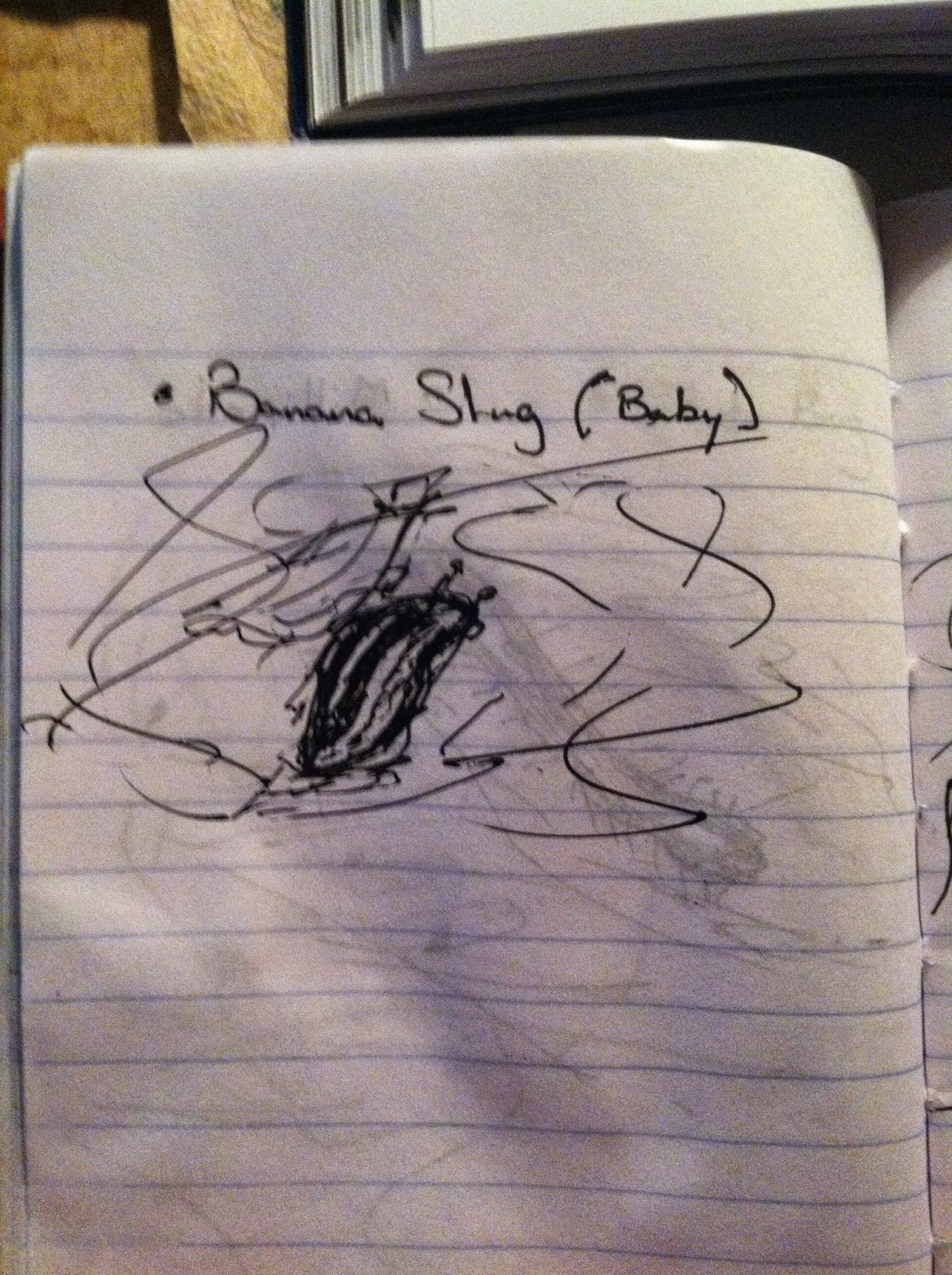
 A baby Banana Slug (Ariolimax Columbianus)
Length 5-10'' body is soft and cylindrical; yellow often with black spots. Eyes are stalked and they have a large breathing hole on the side of their right front. Usually they live on moist forest floors, but i found this little guy in the log right next to the potato bug, I wonder if they live in mutual benefit or if they were competing for space.


 This was a small bug that I found on a leaf near the stump we were looking in, it looks like a small common Ground Beetle (Eleodes Species) or some type of gnat or fly i looked around on the internet and could find anything that seemed to match it. maybe it is an invasive species not native to our region I have seen them around before I will continue to look around about this one.


 Millipede (Harpaphe Haydeniana) The Millipede is around 3 inches long and is gray brown or black, they are rounded with short antennae and dozens of segments each with 2 pairs of legs. They are slow moving and rolls into a small spiral ball when threatened releasing a stink. They live under leaves or stones and logs and are often seen crawling around. In this picture it is hard to find the Millepede but he is upside down almost in the exact middle of the photo just crawling back into the mud.
 This was another log nearby that had been gashed out and it had some spiders inside it that had made webs around the gash. It is another good example of habitat that would contain a lot of diversity and insects.

 Another Potato Bug


 Earth Worm or Night Crawler (Lumbricus Species)
Earthworms are found usually around the same environment that we found our other bugs in moist soils meadowlands or woodlands and yards. They can be up to 5 inches long their body is soft and cylindrical and has about 150 segments. they are a purplish orange and they aerate moist soil. They are commonly found on the surface of the soils after heavy rains and they feed on decaying plant matter. This one was found on the pavement crossing the sidewalk, It seems like this would be a surface that these creatures would try to avoid.


Below are some sketches of the organisms we found:


Wednesday, April 30, 2014

Week Four

Monday April 28, 2014
7:35 pm
Partly Cloudy
63 Degrees
Ravenna Park

          After a nice day and the sun coming out the park is still filled with people walking through. The air is noticeably warmer but still retains a little coolness and it is evident that it is not yet summer. The creek is still running relatively full but is a little dryer around the edges then before, and the mud around the creek has a little bit of a dryer layer atop it. It is becoming apparent that things are changing based on how far you can see, the lower layers of the forest and the brush surrounding the creek as well as in the high canopy of the trees is now filling in quite bit making for a more dense.
          Looking at the close observations things are very similar as to the way they were last time, there is just slightly drier mud but overall the creek and the surrounding in near proximity are very similar. It seems that with the coming of spring and summer I can imagine the creek drying up and getting less and less strong as things dry out only to be down to a small trickle by late august before the fall and winter rains move back in. However the park on a larger scale is changing greatly        
          As we enter week 5 of the quarter the change is evident in species such as the big leaf maple and you can see now the leaves are fully formed and compared to the buds and small leaves i first noticed they are now nearly 4-5 times as big as they were during my last observations. As was the case last time there are plenty of birds around and I will do my best to identify some of the species in this recording. I can pick out at least 5 different calls and hopefully I can spot a bird and record what i notice about it. The focus for this recording was to get at least 8 different species of plants recorded so that is the main goal. The birds interest me and i hope that we as we get further into the course we can learn more how to better identify the species by sounds.

         I did see a bird and from what i could pick out it had an all black head with lighter brown/orange sides that almost speckled out into a white bottom. It was in the underbrush on the other side of the ravine and looking through the field guid I picked it out to be a Spotted Towhee. As far as plant species go the following are some species I came across today:


Nootka Rose (Rosa Nutkana) 
Multiple stemmed shrub
Leaflets are tiny, toothed, serrated and 5-7 ovate
Flowers bloom May-July and are 5-petaled 
Smell wonderful when in bloom!


Dandelion (Taraxacum officinale) 
Traditionally known as a weed and pest in the garden
The flower itself it around 21" with yellow petals 
Stems are unbranched, hollow, "milky juice"


Quaking Aspen (Populus tremuloides) 
Deciduous tree- grows to be around 50'
Leaves are round, toothed and turn yellow in the fall. They also 'quake' in the wind
Bark is smooth and greenish-white


Snow Berry (Symphoricarpos albus)
Shrub that produces inedible white berries in clusters
Leaves are opposite, elliptical and irregularly lobed


Tall Oregon Grape (Berberis-Mahonia aquifolium)Shrub- related to the Drawf Oregon Grape, yet taller in heightLeaves are shiny, opposite, ellipticalBark is light brown, ridgedProduces edible blue berries


Thimbleberry (Rubus parviflorus)   
Shrub
Leaves are 5-lobed, toothed, and fuzzy to touch "nature's toilet paper"            
Produces edible, red berries during the summer months


Vine Maple (Acer circinatum) 
Deciduous shrub or tree, with vine branches
Leaves are opposite, 7-9 lobed, toothed, also produces small flowers
Bark is gray and smooth


Giant Horsetail (Equisetum telmateia)
Tall shrub, in dense clusters often located near damp area like marshes and ditches 
The stalks are hollow but have multiple branches 


Salmonberry (Rubus spectabilis)
Shrub that produces pink flowers that turn into red edible berries 
Leaves are unevenly toothed
Stems have prickles
Grows well in wet habitats 


Thursday, April 24, 2014

Week Three

Weekend of 4/19 - 4/20
Crescent Lake and Salt Creek
Overcast: Rain Saturday, Partly Cloudy Sunday
53 degrees


           The weekend field trip this past weekend was very fun, we learned a lot about the different species that inhabit the pacific northwest whether it was from native vegetation or different species of bird we learned a lot about the history of the region and the development of its local species.
          One of the first things we did after arriving at nature bridge was go for a hike, we learned about the difference between old growth forests and other forests and how they are distinguished and it comes down to a scale of the horizontal and vertical diversities of the surrounding ecosystem. An old growth forest is rich in diversity both horizontally and vertically there are many species of animals and plants that live from the understory all the way through the canopy of the forest and this varies as you move throughout the location.
          We learned of the three components that make up and ecosystem these factors consist of the Structure of the ecosystem, that is the physical elements that it is composed of, secondly comes the Composition of the ecosystem which is what makes up the surroundings or what the structures provide habitat for, and lastly comes the Function, the function what is the work that the ecosystem provides. Function comes in the form of things such as hydrology, carbon sequestration, nitrogen fixation and more. the key to all of this is that it forms a place where diversity is possible and life can function. We also learned of a Landscape which is a nested hierarchy of patches, these patches are each different and make the whole system diverse.
          While we were Hiking we explored the area and followed a trail to a waterfall as shown in the picture, we also hiked up a trail called storming making it halfway or so up the trail but you could tell the difference in species as well as temperature as you made the steep ascent. As we climbed we went from a damp vegetation and ascended to an almost alpine like forest. there were lots of doug fir trees all the way up suggesting a wet environment but as we climbed the trees became shorter and more barren suggesting that the grade of the slope was getting steeper and as a result there may not have been as much soil to use for support of the root systems. There was more exposed rock as we got further up the hill and you noticed that the footing became less and less solid as we hiked up the rocks, there was less finer soils and the moisture content was still high from the large amount of rain. The greater exposure made the wind come through the trees much more easily and made it seem as though it was raining harder as the canopy of the forest did not protect you. We saw a Gray Jay (Perisoreus Canadensis) at the highest point we hit and watched it for a while before we turned around and headed back down the mountain. As far as the faces of the mountain when gong from the west facing slopes the the east facing slopes especially in the valley it was clear how they differed. There was a lot more Salal on the western facing slope which receives more afternoon sun and thus is drier than the east facing slope, Salal is characteristic of a dryer type of environment as well as Madrone which was more prevalent on the west side as well.
          After the Hike I came back and did a small sketch of the lake and then rested up, the food was really good. The next day we woke up early and did a bird walk. Some of the species we spotted and heard included: Stellar Jay, Red Breasted Nut-Hutch, White Crowned-Sparrow, Pacific Wren, Chicadee's (of multiple types), and a Varried Thrush. One of the coolest parts of the bird walk was learning that there are many different calls that go on and that if you can learn the calls you will have a good knowledge of the birds.
          After the Bird walk we ate breakfast and headed out to Salt Creek. For me growing up in the area and having been to Crescent Lake and Salt Creek multiple times as a kid, as well as going to Salt Creek in HS for cross country races I felt at home in the area and on the tide flats and exposed rock. The cool thing is there is still so much that I learned about the area after being there for the field trip. One of the first things is that there is a large amount of erratics in the area, the granite stands apart from the surroundings, but outside of the rock there is examples of all kinds of species diversity. From the Bob Paine lecture we learned that the interaction of the coast and the sea is one of the most diverse places. From the photos you can see some of the things Bob explained in his lecture. There was a lot of species competition for space that was apparent. In spots of the Mussel beds you could see where waves had carved out bare rock patches that were being inhabited by other organisms. Where the Mussels did grow they would only occupy up to a certain spot probably marked by the intertidal limit after that there would be a succession of other species that took over the rock. Within the tidal pools we could see a wide range of diversity, there we all kinds of sea stars, anemones and fungi. The variety was endless and the sheer number of different organisms was mind blowing. At the end of the post I have a list of species compiled that we saw during the day at the tide pools, the list probably doesn't even cover half the number of species that were actually present. One of the things that Bob explained was a trophic cascade. This is a cascade that affects multiple species that depend or are linked to one another. An example of this would be More killer whales would result in less otters, otters eat sea urchins so less otters would allow for more urchins, and urchins eat kelp so more urchins would result in less kelp. This example of how species interact is very important especially in ecosystems as diverse as the costal zone.


Below is compiled a species list as well as a few pictures of different species that we saw.


SPECIES:

Isopods
Sea Lion
Flounder
Eel
Sea Star (Blood, Okar, Sun, Striped)
Dunlin
Racoon
Rockfish
Marbled Murlet
Oyster Catcher
Harlequin Ducks
River Otter
Rose Anemone
Chitins
Sandpiper, Surfbirds
Loon
Scooter


Sea Urchin                                                                  Larch


Pacific Yew                                                 Chocolate Lily


Wednesday, April 16, 2014

Week Two

Tuesday April 15, 2014
4:56 pm
Partly Sunny, Warm Muggy
59 degrees
Ravenna Park Erratic

          After having class this morning in the park I learned a lot. One of the first things we covered was lichen on red alder trunks and how they do not like to grow in the city, we learned they are highly sensitive to pollution and thus do not survive well near the city. I still find it awkward to be in the middle of the park conducting observations, not because of the act itself which i actually enjoy but more because of the looks and smirks i receive by the passerby's. I returned to Ravenna this afternoon to record some more observations, and found some interesting changes.
          Though the creek is still running relatively full and hasn't changed much in its flow volume since last week there is a lot more green to be noticed. The Big Leaf Maples which was one of the species we learned about today has bloomed and their leaves are a nearly neon green, that stands out and is a distant cry from their fall browns oranges and yellows. The leaves are small and yet to mature but their difference seems to add a thickness to the canopy that was not present last time. I assume this will only grow more apparent as spring continues.
         Looking into the river itself I find very fine sands, clays and silts that have dropped out of suspension. They sit atop larger almost black rock that would have been moved there during a high flow event. There are many particles of bark and leaf floating down stream and where the stream narrows the sand and silt are flushed away leaving only the dark rock bed. Judging by the bottom of the creek bed I can tell where the water moves quickly or slowly and where the pools form behind larger rocks there is a clam that is serene. A few water bugs or water striders as the field guide refers to them.
          In addition to the Big Leaf Maples there is a lot of Skunk Cabbage and Lady Ferns (a species that we learned about today, before which I only knew of deer ferns and sword ferns). And there is a lot of Birds. We saw a Black Capped Chickadee today which was cool that is the first time I have identified a Bird that I did not already know.

For the sketches portion of this week I focused on the Western Red Cedar: